Silence at the library: Inside Cairns’ controversial flying-fox relocation
Cairns Regional Council says it successfully moved an endangered flying-fox camp away from an unsuitable city roost, but questions remain over whether the dispersal solved the problem or redefined what success looked like.
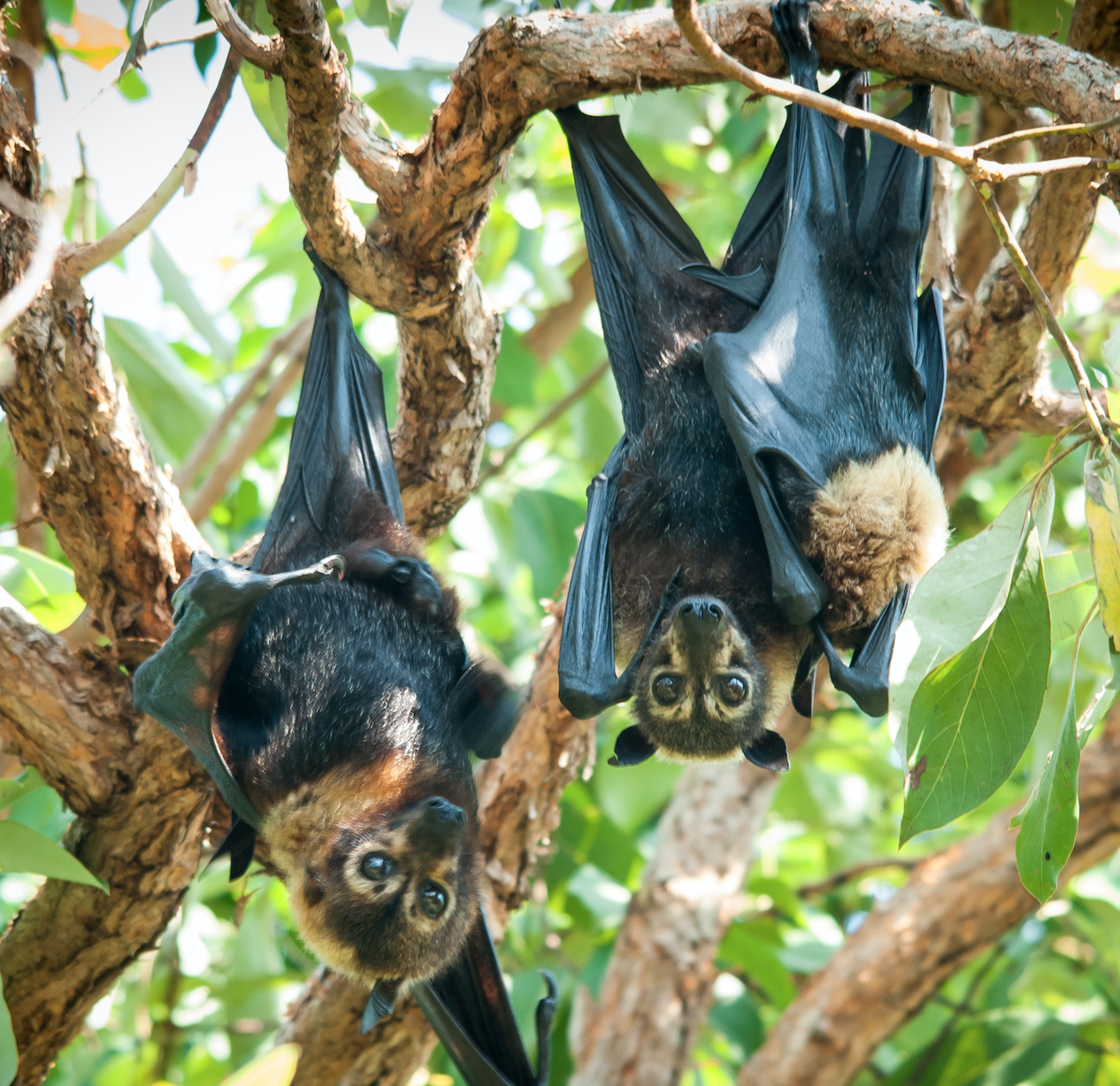
A programme of relocation was undertaken for the spectacled flying foxes in Cairns city centre. Image: J. Welbergen.
At 4am on a July morning in 2020, while much of Cairns was still asleep, teams gathered around the city library to move thousands of endangered spectacled flying-foxes out of the heart of the city.
The methods were officially described as non-lethal. They included lights, sound, human presence and other deterrents. Cairns Regional Council told residents not to be alarmed if flying-foxes passed overhead. “This is expected,” it said in a media release.
Five days after the operation began, Council announced that relocation activities had “successfully discouraged the majority of the animals from returning to the site or settling in other areas within the CBD”. It said deterrent operations would continue from 4am every morning for up to 30 days.
More than five years later, the library trees are no longer a daytime camp. By that measure, Cairns got what it wanted.
But documents released through Freedom of Information, council meeting papers, scientific studies, monitoring charts and interviews with people involved in the long-running dispute suggest the story is not so simple. The camp was nationally important, the species was endangered, and approval was conditional. The costs kept rising, deterrents continued, and, according to critics, flying-foxes kept trying to return.
Many of the questions now surrounding the relocation are not provided in hindsight. They were in the public submissions before approval. Council received 596 responses, with key issues including the removal of an important roost from the species’ overall habitat, little or no consideration of alternatives, a high likelihood of failure, cost to ratepayers, aviation strike risk, insufficient detail on monitoring and contingency planning, and risk of harm to both humans and spectacled flying-foxes.
“Their success was that the flying foxes weren’t in the town,” said Maree Treadwell Kerr, president of the Bats and Trees Society of Cairns. “If you’re looking at just that one camp, then yes. And so that’s what they say. Council says, yes, it was a great success. The flying fox was no longer there in the city. You cannot look at one camp on its own.”
A nationally important camp in the middle of the city
The spectacled flying-fox is not a minor urban nuisance species. It is a large fruit bat found in Australia mainly in the Wet Tropics of north Queensland. It feeds on fruit, nectar and pollen, moves seeds and pollen across fragmented landscapes, and is listed as endangered under Australian federal law.
For years, one of its most visible camps was in central Cairns, around the City Library and nearby hotel and street trees. The Commonwealth approval documents describe the Cairns City Library site as a 4,000 sq m camp on the fringe of the central business district, containing between 3,000 and 8,000 spectacled flying-foxes depending on season.
Council argued the relocation was needed because the site had become unsuitable. In approval documents, it cited diminishing habitat quality, heat impacts, high-rise construction, noise and other urban pressures. The Commonwealth Department noted Council’s view that, if no action was taken, there was a risk of losing roost trees at the library site and further harm to the species.
In written responses to questions for this article, Cairns Regional Council said the dispersal was intended to reduce spectacled flying-fox deaths, protect heritage-listed fig trees, reduce conflict in the CBD and encourage the animals to move to a safer location. Council said it considered the action successful because there was no harm to flying-foxes from the approved dispersal, no increase in pup deaths elsewhere, and a significant reduction in deaths at the City Library.
The problem is that the official approval did not simply authorise Council to clear a nuisance site. It approved a controlled action to “permanently relocate” an endangered population from a nationally important camp to Cairns Central Swamp, under conditions intended to avoid unacceptable impacts on the species.
The shrinking CBD roost
The City Library was not the only place in central Cairns where spectacled flying-foxes had roosted. Documents and images supplied by conservation groups show a wider CBD roost network around the library, Novotel Cairns Oasis Resort and nearby streets, with trees historically used by flying-foxes progressively pruned, removed or altered before the 2020 dispersal.
Council’s case for relocation partly rested on the argument that the library site had become unsuitable: too urban, too damaged, too risky for the animals and too difficult for the surrounding community. Conservation groups do not dispute that the site had become pressured. Their argument is that the pressure was not inevitable.
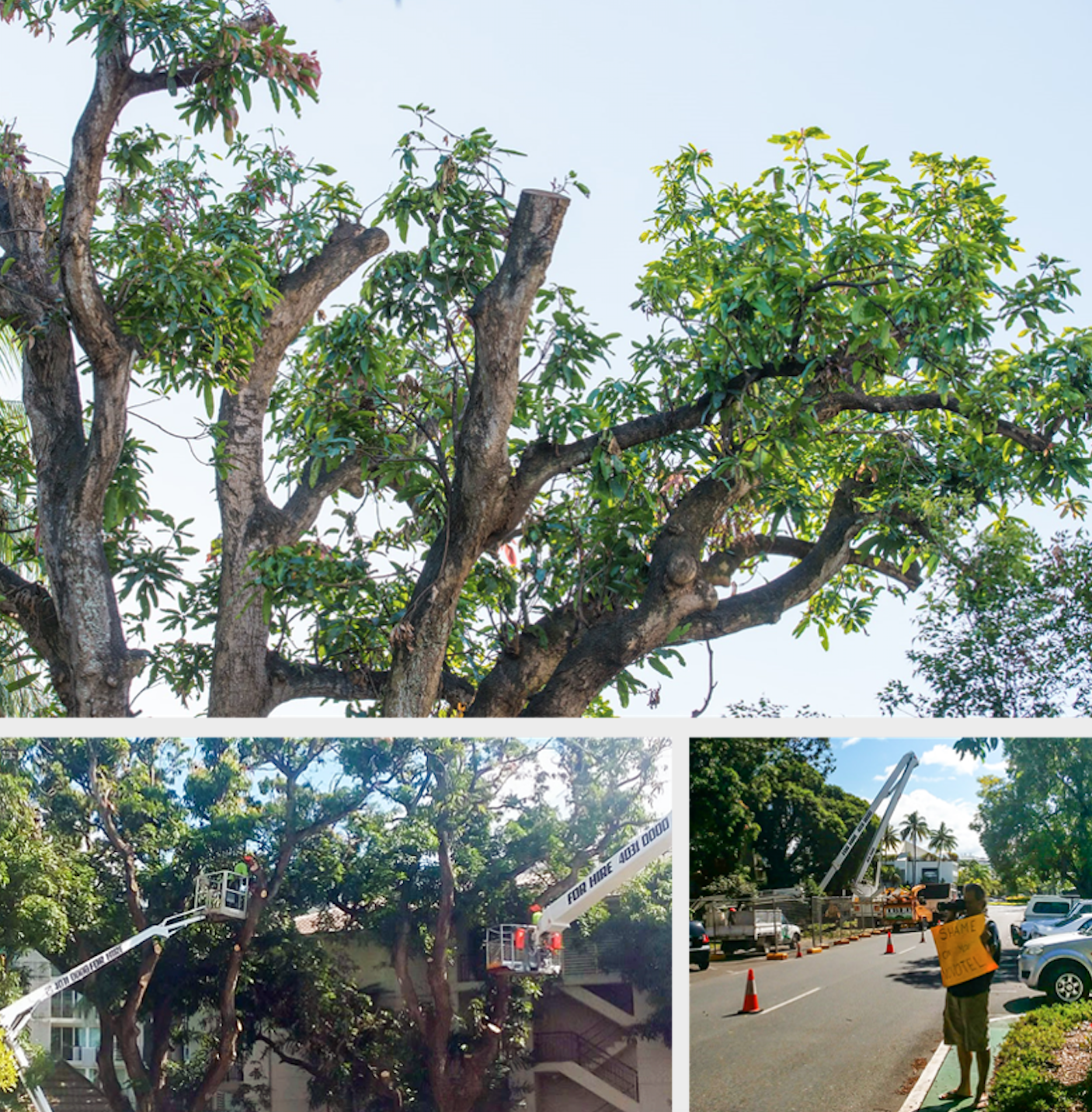
Tree pruning around Cairns’ CBD flying fox camp before the 2020 dispersal. Conservation groups said roost tree loss helped push spectacled flying foxes towards the City Library; Council said relocation was needed because the site had become unsafe and unsuitable. Images: Welbergen/Preece.
Treadwell Kerr said the dispersal could not be understood without looking at what had happened to roosting habitat around the library in the years before the relocation.
“They removed so many of the trees,” she said. “And then they said, ‘Oh, look, the flying foxes are causing too much damage to the trees that are left.’”
The Bats and Trees Society of Cairns argues that pruning and removal of nearby roost trees helped push more animals into fewer remaining trees, increasing stress on the library camp and making the later welfare case for dispersal stronger. Council has said the relocation was needed to reduce flying-fox deaths, protect heritage-listed fig trees and move the camp to a safer site.
The issue is therefore not simply whether the library site was under pressure by 2020. It clearly was. The more difficult question is how much of that pressure was created by previous management and development decisions — and whether the final “solution” treated the library camp as the problem, rather than the last visible symptom of a shrinking roost network.
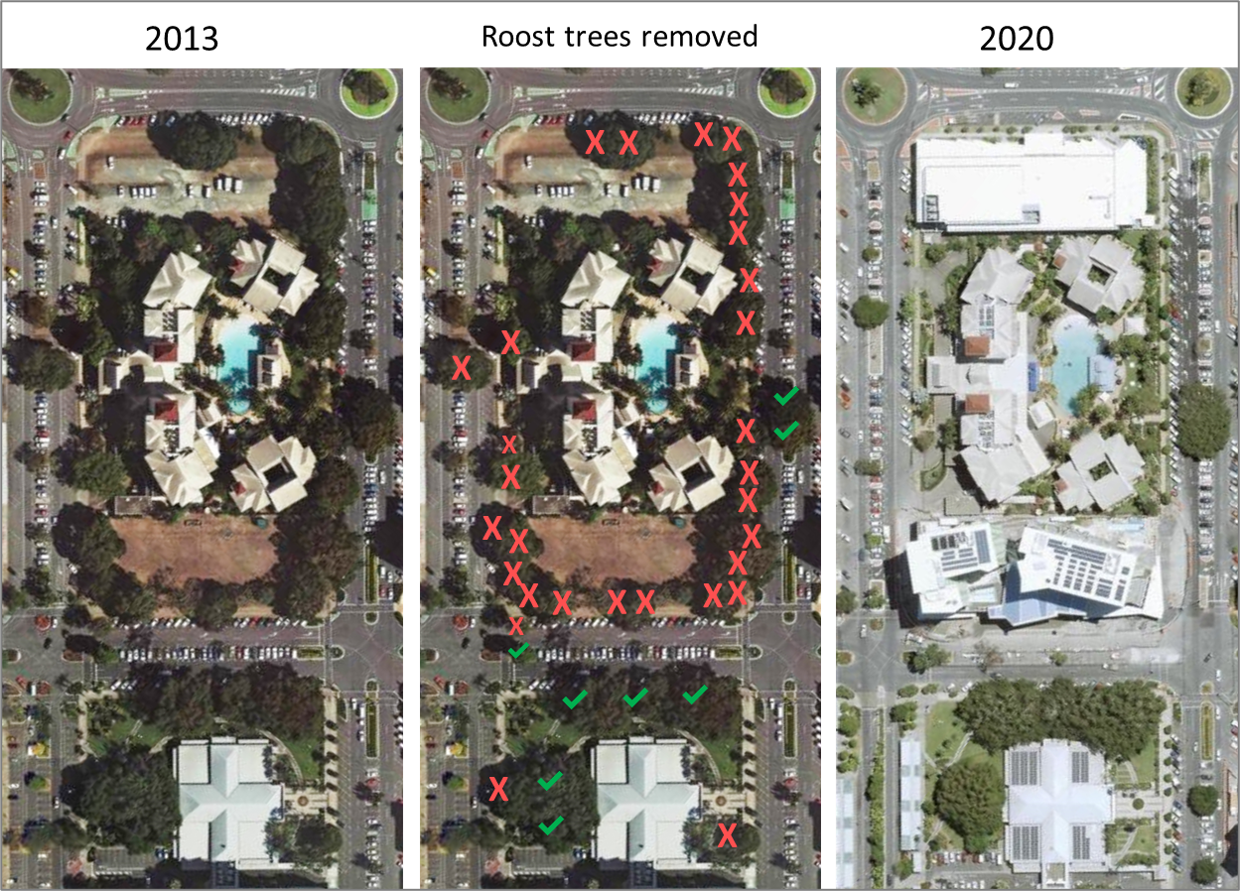
Roost trees removed around Cairns’ CBD before the 2020 dispersal. Conservation groups say the loss of nearby habitat helped push spectacled flying-foxes towards the City Library. Image: J. Welbergen.
If the only measure is deaths at the original library site, the numbers may look good. If the measure includes animals displaced to other roosts, pups rescued by carers, repeated disturbance, or attempts to return, the picture becomes harder to assess.
Treadwell Kerr said there was no adequate baseline. “We don’t know what the natural mortality is,” she said. “We have no baseline data on any of this, so we don’t actually know what it is you’re measuring against.”
The bats that kept trying to come back
Monitoring charts included in the document set show flying-foxes repeatedly flying over, attempting to land or attempting to roost at or near the City Library after the initial dispersal. The charts record peaks in late October and early November 2020, with further pulses through 2021.
The figures do not prove the dispersal failed. A council could argue the opposite: that repeated deterrence prevented the animals from re-establishing the roost. But they do complicate the idea that the flying-foxes simply moved to a new, safer home and stayed there.
Treadwell Kerr said the animals still use the area at night.
“If they stopped all the actions altogether, the flying foxes would be sure to come back,” she said. “They feed there at night time. They come there at night time and feed. But they don’t stay around during the day.”
Council’s 2024 Flying-fox Management Strategy shows monitoring remained central to the management of the City Library roost. It says monitoring is required to “validate success” and avoid adverse impacts, and lists success criteria including nil spectacled flying-fox deaths, no increasing trend in pup mortality relative to estimated population, daily monitoring at the library, CBD and Brinsmead Reserve Park during operations, and monthly roost counts within 30km by consultants.
The strategy also says council monitoring data and roost history may be shared with research organisations on request.
For an endangered, mobile species, that data is not a bureaucratic detail. It is the evidence needed to test whether “success” meant a better outcome for the animals, or simply no animals at one site.
A costly success
The financial record also complicates the public story.
By July 2021, council papers show flying-fox management expenditure for 2020/21 had reached $1,688,709, far above the $510,000 budget. This included $433,822 in consultancy fees for the Flying Fox Management Plan and $1,215,056 in horticultural, deterrent and maintenance works. The same report said officers had not known “the extent of required activities and/or the duration of these activities” when forecasting the budget.
The report added that deterrent activities would continue, with an approved budget of $660,000 for 2021/22 for deterrence, bat carer support and consultancy.
This is not a small detail for ratepayers. It suggests the library dispersal did not end with a one-month relocation. It became an ongoing management programme.
That was not a surprise to flying-fox researchers. A 2021 review of dispersal attempts at Australian flying-fox camps found repeated actions over months or years were typically required in 58% of cases. Replacement camps formed within 1km in 88% of cases, and only 23% of dispersal attempts successfully resolved conflict for communities. No dispersal attempt costing less than AU$250,000 was successful.
Why flying foxes do not follow council boundaries
Professor Justin Welbergen, an animal ecologist at Western Sydney University and former president of the Australasian Bat Society, said the word “relocation” itself is misleading.
“Relocation is a complete misnomer,” he said. “It’s just not based on the biology of the species.”
Flying-foxes are not like a colony of animals that can be lifted from one fixed home and placed in another. They move through networks of roosts and feeding sites, tracking food across landscapes. A satellite-tracking study led by Welbergen found 201 tracked flying-foxes used 755 roost sites, 458 of which had not previously been recorded.
The paper concluded that a roost is better understood as a “node” in a wider network of staging posts, and that local management actions can reverberate across jurisdictions.
Welbergen said this matters for Cairns because judging one site in isolation misses the way flying-foxes actually live.
“The evidence really shows that dispersal is ineffective and even counterproductive,” he said. “It can make a bad situation worse in the short term as well as in the long term.”
This does not mean urban flying-fox camps are easy for residents. They can be noisy, smelly and stressful for people living directly underneath them. Even Treadwell Kerr, who opposed the dispersal, said the early-morning noise was often the main source of conflict.
“The noise is the main thing that people bother with the flying foxes,” she said. “When the flying foxes arrive first thing in the morning, about five o’clock in the morning, they are very, very noisy for a period of time.”
But she argued there were other ways to reduce conflict, including buffers, double glazing, vegetation management and education. “If you can actually solve the noise problem, and you can do that with double glazing, the complaints just go right down,” she said.
Urban bats are not going away
One reason dispersal is so difficult is that flying-foxes are increasingly using urban landscapes.
A study of spectacled flying-foxes in the Wet Tropics found the number of urban camps occupied each year increased between 1998 and 2012. The researchers found no significant change in the proximity of camps to urban areas or in land cover around camps that would support a simple explanation of urban expansion swallowing old roosts. Instead, they suggested urbanisation may be a behavioural response to advantages offered by urban locations.
Other research has found flying-foxes are exploiting human-modified landscapes, including parks, gardens and planted trees. These landscapes can provide more stable or abundant food resources.
That makes the Cairns case part of a bigger problem. Cities are not just places flying-foxes accidentally end up. They can be part of the resource landscape that attracts them.
Former Cairns councillor Rob Pyne said this is precisely why he believed the city had missed an opportunity to live with the animals rather than simply move them on.
“It seems to me endangered species are valued least where they are,” he said. “I would see tourists come and be amazed.”
Pyne said alternative ideas had been discussed by people opposed to the relocation, including viewing platforms and tourism-style interpretation. “The green side of politics is pretty creative and a lot of those sort of ideas came through,” he said.
But he said he felt the political direction was already clear.
“I think they wanted to move on,” he said. “They felt they had public support.”
Tourism asset or civic nuisance?
The Cairns flying-fox dispute has always sat awkwardly between ecology, tourism and amenity.
To some residents and businesses, the camp meant smell, noise, droppings and a poor image for the CBD. To others, it was a rare chance to watch thousands of large fruit bats leave their roost at dusk against the backdrop of a tropical city.
Treadwell Kerr said she used to take visitors to watch flying-foxes when she lived near a colony.
“We used to take people down to the bridge to watch it every time we had people around,” she said. “It was only a 10-minute walk, watch the flying foxes, and then come back for the rest of the barbecue. So, you know, it was a great drawcard.”
Visitor comment-book photographs and BatSoc material supplied for this investigation show tourists leaving messages such as “Love the bats in their natural habitat”, “Bats are beautiful — and vital to our forests”, and “Don’t persecute them”. These comments are anecdotal, not a scientific survey, but they challenge the idea that the animals were only a reputational problem for the city.
Pyne said Cairns had to decide what kind of tourism it wanted.
“There’s tourism and there’s tourism,” he said. “Bird watchers come to Cairns and they’re really top-end tourists.”
The approval required the camp and alternative sites to be monitored for changes in numbers, roosting extent, ill health, death or injury, behavioural changes and signs of stress attributable to the action. The results were to be reviewed daily by a suitably qualified expert, who would decide whether activities could continue. That makes the monitoring records central to any independent assessment of success.
What the public still cannot see
The most important unanswered question is not whether the library is now free of daytime roosting flying-foxes. It is.
The question is whether the dispersal achieved the broader ecological and welfare outcomes that justified intervention in a nationally important camp of an endangered species.
Council says independent monitoring has shown the dispersal and ongoing deterrence have not reduced the regional spectacled flying-fox population. It says the animals are believed to have dispersed into a broader network of around 75 roost sites in the local government area. It also says daily deterrence continues in the CBD under Queensland’s Code of Practice.
But much of the raw monitoring data, compliance material and long-term outcome assessment is not easily visible to the public. A council strategy says monthly roost count information is collected and held internally, while the original approval documentation says monitoring was required to validate success and allow timely intervention.
For Treadwell Kerr, the missing issue is scale.
“To prove that this dispersal was a success, you would have had to have no increased wildlife conflict throughout the Cairns region,” she said. “You cannot look at one camp on its own.”
Council rejected the implication that success should be judged only by the claims of critics. It said its dispersal reduced deaths at the library, avoided harm during the approved action, and informed a more cautious staged approach to future flying-fox management. When asked detailed follow-up questions, Council said it had provided extensive information and directed further specific questions to Freedom of Information processes.
That leaves the public with two different definitions of success.
One is simple: there are no bats roosting at the library.
The other is harder: where did the bats go, what happened to them there, how much did it cost to keep them away, and what evidence is public enough for anyone outside Council to verify the outcome?
The silence at the library
Today, the library trees no longer hold the same dense daytime colony that once made Cairns’ CBD famous to some and intolerable to others. To Council, that is proof the relocation worked. To its critics, it is proof only that enough effort and money can keep an endangered animal away from a place it still tries to use.
For Welbergen, the lesson is bigger than Cairns. “Flying foxes keep these increasingly fragmented forest landscapes together,” he said.
That is what makes the Cairns case more than a local dispute about noise, droppings, and trees. It’s a test of how cities manage the wildlife that thrives in them, and whether moving a conflict out of sight is the same as solving it.
The bats are gone from the library by day. The question is whether that silence is the sound of a success.